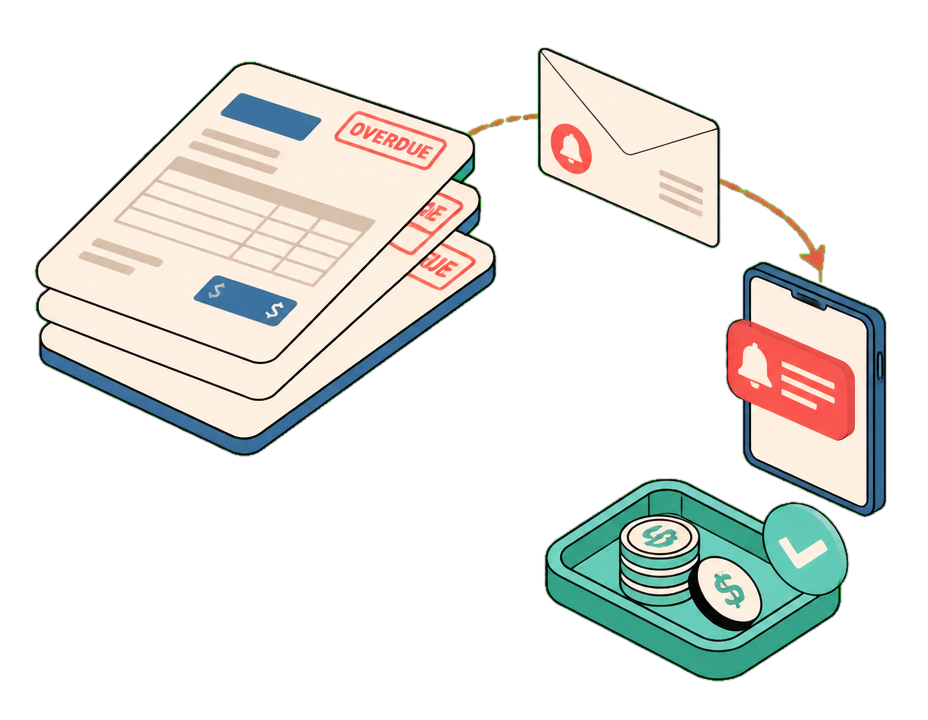
A droid that works receivables the way a patient, persistent human would: it watches every open invoice, sends the right reminder at the right time over the right channel, logs each promise to pay, and escalates only the genuinely stuck accounts — remembering how each customer tends to pay so the nudges land instead of nag.
Does
Chases invoices, logs payments
Where
Services business, ~12-person team
Reaches people on
Email, SMS, Slack
Works inside
QuickBooks, Stripe
Runs
Daily · on every open invoice
01The situation
The work that gets invoices paid is relentless, so it slips.
Overdue invoices piled up because chasing them was awkward, repetitive, and nobody’s actual job. A reminder would go out when someone remembered, which wasn’t often, and the persistence that actually gets invoices paid — a gentle nudge, then a firmer one, then a call — rarely happened consistently.
So cash that was already earned sat in receivables for weeks longer than it needed to. The work wasn’t hard; it was relentless and uncomfortable, which is exactly the kind of thing that quietly slips.
02How it works
How the droid took it on.
Rather than chase invoices in guilty bursts, the team handed collections over. Every morning the droid works every open invoice on its schedule, logs the promises, reconciles the payments, and escalates only the genuinely stuck.
TASK#231AR & collectionsstanding
trigger
Every weekday at 9:00am, a full receivables run
also
Any payment received, and customers' replies
scope
Every open invoice
runs as
A contained droid action per invoice or reply
memory
How each customer pays: channel, tone, what works
Set up once, in plain language: “chase every open invoice politely and persistently, log promises and stop nagging, and only pull me in when an account's genuinely stuck.” The droid turned that into a standing job, the collections discipline that quietly protects cash flow.
FIG. 1The durable task, exactly as it exists in the runtime.
The morning run, customers' replies, and incoming payments land on the left. Watch the droid pick up each one and work it across the ledger and Stripe, pulling in a human only for the account that's truly stuck.
The result
What changed, by the numbers.
Lower DSOcash collected days sooner, consistently
Chased on schedulereminders go out on the ageing steps you set
~1 in 8accounts escalated, with the rest handled
Better last toucha thank-you, not a nag, when they pay
An illustrative workflow built from real product mechanics. The connected apps, the schedules and the run handling are how a droid actually works; the companies, the people and the figures are composites rather than a customer's numbers.
Try this workflow
Run this workflow yourself.
Copy the brief below and paste it into Unify. It’ll walk you through the prerequisites, connect what it needs, and stand the workflow up with you.
Workflow brief
I handle finance and ops at a services business, and chasing overdue invoices is the job everyone avoids. Reminders go out when someone remembers, which isn't often, so the persistence that actually gets invoices paid almost never happens consistently, and cash we've already earned sits in receivables for weeks longer than it should.

Own accounts-receivable collections. Apps/channels: QuickBooks (invoices and the ledger), Stripe (payments), Gmail and SMS (reminders), Slack #finance (the daily digest and escalations).

Run a full receivables run every weekday morning, and react to payments and customer replies as they come. On each run:
1. Pull every open invoice and how overdue it is, and reconcile any payments that arrived so you never chase a paid invoice.
2. Tier the rest by how late they are and how each customer usually pays.
3. Send the right reminder over the right channel, gentle for the just-late and firmer for the long-overdue.
4. Post an AR digest to #finance.

When a customer promises to pay, log the promise, pause reminders until then, and check back. When a payment lands, mark it paid, reconcile it, and send a thank-you with the receipt. Use judgment on escalation: keep chasing the normal cases, but when an account is far overdue with reminders ignored and a material balance, hand it to the finance lead with the full timeline. Remember how each customer pays: channel, tone, what works.