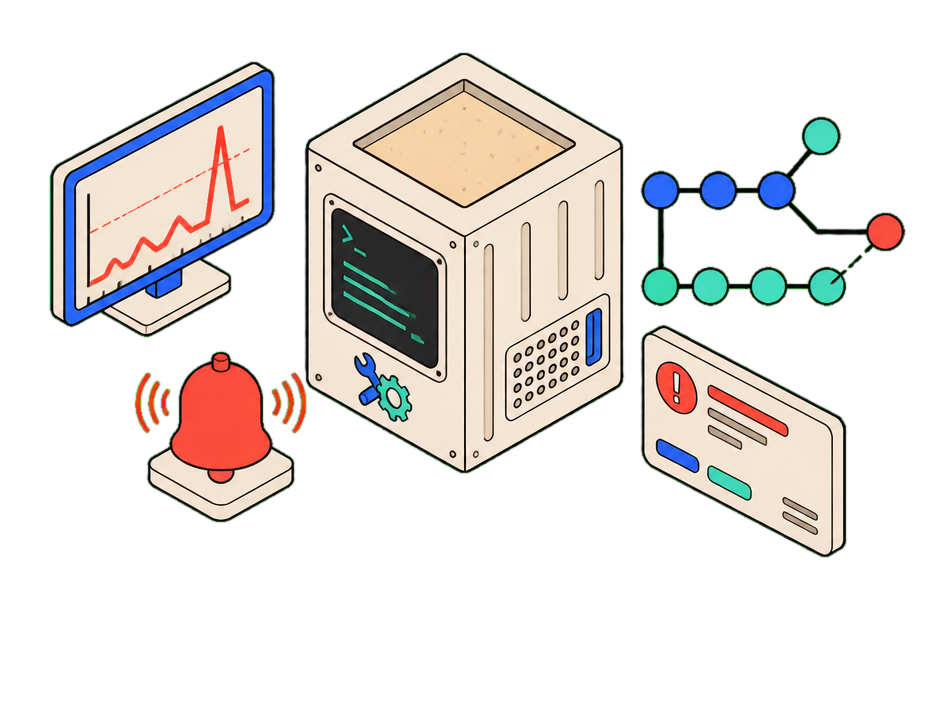
A droid that wakes on every alert: it gathers the logs and the recent deploys, reproduces the failure on its own sandboxed machine, and files a clean issue with the root cause — paging a human only for the incidents that truly need one, and remembering every flake so the next alert is never a cold start.
Does
Triages alerts, reproduces & files them
Where
SaaS platform team, ~12 engineers
Reaches people on
Slack, paging
Works inside
Sentry, GitHub, Linear
Runs
On every alert · 24/7
01The situation
Most alerts aren't incidents, but you dig every time to find out.
Every alert pulled an engineer out of whatever they were doing. Most turned out to be a known flake or a bad deploy — but you couldn’t know that until you’d opened Sentry, read the stack trace, checked what shipped recently, and tried to reproduce it. The digging was the same every time; only the answer changed.
Nights and weekends were the worst of it. A page at 3am usually meant twenty minutes of context-gathering before you even knew whether it mattered, and the noisy alerts trained everyone to half-ignore the channel — which is exactly how the one that mattered slipped through.
02How it works
How the droid took it on.
Rather than ask an engineer to triage every red notification, the team handed first response over. The moment an alert fires the droid gathers the context, reproduces the failure on its own machine, files it cleanly, and pages a person only when it’s real and urgent.
TASK#418On-call triagestanding
trigger
Any alert from monitoring (Sentry)
also
A shift-end digest to #on-call
scope
Every service alert · 24/7
runs as
A contained droid action per alert, on its own sandboxed machine
memory
Per-service notes: known flakes, recent incidents, owners
Set up once, in plain language: “when an alert fires, gather everything, try to reproduce it, file it cleanly, and only page me if it's real and urgent.” The droid turned that into a standing job that owns first response, so the team stopped getting dragged out of flow by every red notification.
FIG. 1The durable task, exactly as it exists in the runtime.
Every alert trips the same loop:
01Alert firesSentry / monitoring
02Droid wakesOn its own machine
03Reads logs + deploys + memoryError, release, past flakes
Alerts and the occasional engineer question land on the left. Watch the droid pick up each one and work it end to end across Sentry, GitHub and Linear, and on its own machine, paging a human only for the incident that warrants it.
The result
What changed, by the numbers.
Minutes, not 20to a reproduced, written-up issue
~1 in 3alerts that reached a human, with the rest handled for them
Signal separatedreal incidents split from routine alert noise
Quiet nightspages only for what's real and urgent
An illustrative workflow built from real product mechanics. The connected apps, the schedules and the run handling are how a droid actually works; the companies, the people and the figures are composites rather than a customer's numbers.
Try this workflow
Run this workflow yourself.
Copy the brief below and paste it into Unify. It’ll walk you through the prerequisites, connect what it needs, and stand the workflow up with you.
Workflow brief
I lead a small platform team, and on-call is wearing us down. Every alert drags someone out of flow to do the same dig: open Sentry, read the trace, check what shipped, try to reproduce it, and most of the time it's a known flake or a bad deploy. Nights are the worst: a 3am page is usually twenty minutes of context-gathering before you even know if it matters, and the noisy alerts have trained everyone to half-ignore the channel.

Own first response to alerts. Apps/channels: Sentry (alerts, errors, releases), GitHub (recent deploys, commits, reverts), Linear (filing and assigning issues), Slack #on-call (triage notes and paging). Use your own sandboxed machine to actually reproduce failures.

Run whenever an alert fires, plus a shift-end digest to #on-call. For each alert:
1. Read the error, how often it's firing, and which release it's on.
2. Check what shipped recently in case a deploy is the cause.
3. Spin up a clean copy of the service on your own machine and try to reproduce it.
4. If it's a real bug, file an issue with the stack trace, repro steps, your root-cause hypothesis and the suspect commit, and assign it to the service owner.
5. Post a short triage note to #on-call so people know what's happening.

Use judgment on what reaches a human: auto-resolve known flakes and transient noise, file and assign real bugs, and page the on-call engineer directly, with full context, only for genuine, urgent incidents. Remember known flakes and recent incidents per service so each alert starts from what we already know, not from scratch.